

The Amplification Hypothesis
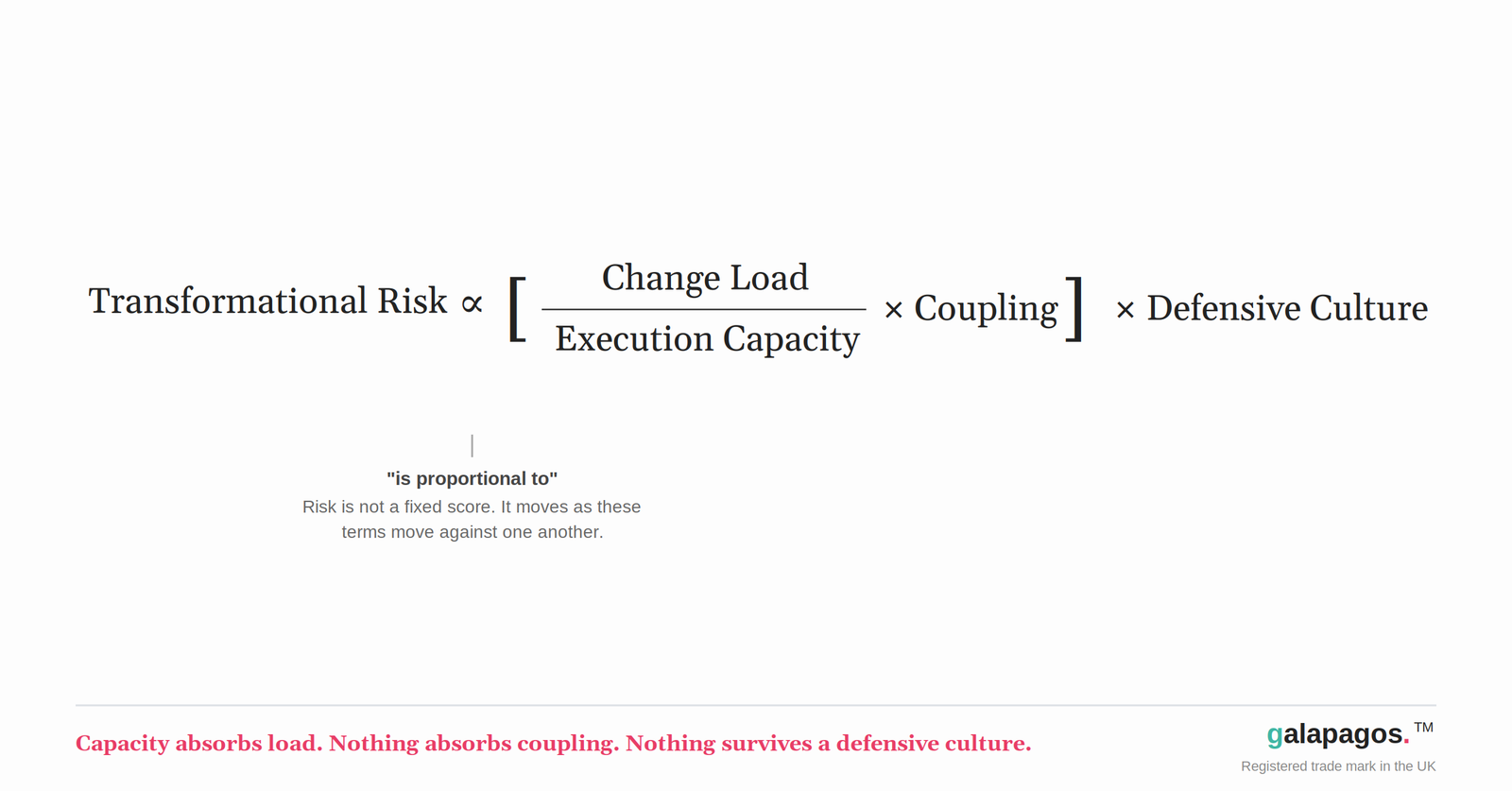
The dimensions on the right-hand side interact, and it is this interaction that amplifies the risk of failure. Everything we blame when a transformation fails sits inside them: size, pace, concurrency, dependencies, sponsorship, skills, readiness and a great deal more. Assess any one of them on its own and you will misjudge the risk.
Load and coupling multiply. Falling capacity raises the risk with nothing new added. A defensive culture multiplies everything inside the brackets, because it hides coupling, lengthens the response delay and drains capacity at the same time.
Capacity absorbs load. Nothing absorbs coupling.
Nothing survives a defensive culture.
What the paper is
An eight-page abridged working paper, written for people running live transformations. The hypothesis was frozen first. Six major transformations, four that failed and two that succeeded, were then researched in depth and scored against it. The results backed the hypothesis in all six cases.
- Care Quality Commission, Birmingham City Council Oracle and the Emergency Services Network: the three UK failures.
- Target Canada: a completed failure with a clear strategy and a visible sponsor.
- Netflix and Capital One: two successes chosen because they should have broken the model, with the conditions that would count as breaking it written down before scoring began.
Six external cases. 238 evidence observations. Seventeen failure mechanisms frozen before scoring.
What it covers
- The argument in one page.
- The Amplification Hypothesis and what follows from it.
- The four terms: Change Load, Coupling, Execution Capacity and Defensive Culture.
- The six cases, and where they differ.
- What the model does not claim.
- How to prove it wrong.
What it does not claim
The model is evidence-informed and can be tested in flight. It is not a statistically validated predictor, and it does not estimate the probability that any transformation will fail. Six cases are enough to reject the simple explanations and sharpen the model. They are not enough to calibrate it, and the paper does not pretend otherwise.
Prove it wrong
A model that cannot be proved wrong is not worth your time. This one can. Two kinds of case would do it: a large transformation that failed with low coupling, strong Execution Capacity, an open culture and a short response delay; or a tightly coupled, overloaded programme with weak capacity that succeeded inside a defensive culture. Send me the case and I will score it against the frozen model and publish the result whichever way it falls.
The full research paper, the seventeen-mechanism register and the assessment protocol are available on request. Contact Brian Harkin at brian@digitalxform.co.uk. Abridged working paper v1.1 condenses the Galapagos Transformation Risk Model research paper v1.1. Galapagos is a registered trade mark in the UK.